Tuesday, December 31, 2013

Bull market shows no sign of death with Yellen support

stocks, market, yellen, bonds, economy, unemployment, federal reserve, taper, quantitative easing, ben bernanke

The weakest employment recovery in seven decades is proving a boon to equity markets.

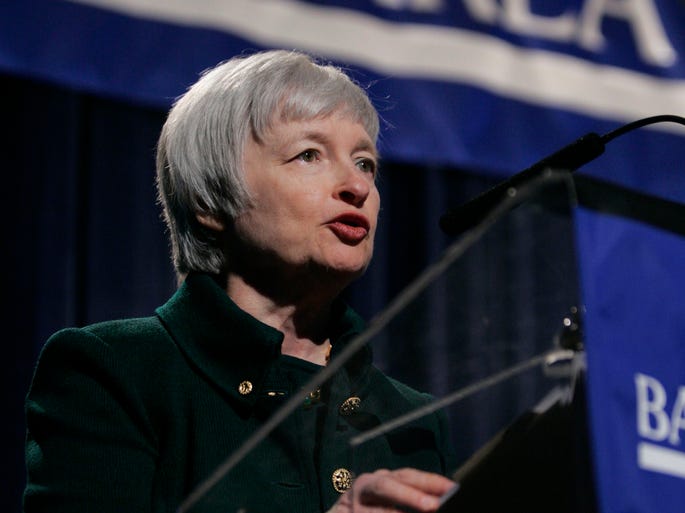
Five years into a rally that has restored $14 trillion to share prices, U.S. payrolls remain 1.5 million below the level in 2008, according to data compiled by Bloomberg. Resistance to hiring from ConocoPhillips to Walt Disney Co. will help push Standard & Poor's 500 Index profit margins above 10% next year, the highest ever, data show. Below-average employment was cited last month by Federal Reserve chairman nominee Janet Yellen as the biggest obstacle to raising interest rates.

While American workers struggle, investors are benefiting as expense reductions and record low borrowing costs drive profits and underpin a 167% advance in the S&P 500 over the past 57 months. To bulls like Michael Holland at Holland & Co., equities will keep rallying as long as the Fed remains more concerned about employment than inflation.

“The weakness in jobs is continuing fodder for the Fed to fulfill its most recent and steadfast comments about the support of the economy,” Mr. Holland, who oversees more than $4 billion in New York, said in a phone interview. “Until the labor market gets better, the two parts of dual mandate have to be served,” he said. “I'm still pretty set in my position and prepared to see the market go higher.”

Top 5 Dividend Companies To Own For 2014

COMPENSATION DOWN

Employee compensation has declined relative to net corporate profits. The ratio of U.S. wages to earnings dropped to 3.2 in the second quarter, the lowest since 1966, according to data from the Bureau of Economic Analysis. Wages were the highest compared with earnings in 2008, just as the financial crisis was taking hold. The measure averaged 4.5 from 1947 to 2008, BEA data show.

Profitability at S&P 500 companies has increased, with each dollar of sales estimated to generate a record 9.9 cents in net income this year, data compiled by Bloomberg show.

ConocoPhillips, the largest U.S. independent oil and natural gas producer, cut its workforce three of the last four years, while profit margins expanded to 15% in 2012. That compares with 3.3% in 2009, data compiled by Bloomberg show.

Walt Disney Chairman and Chief Executive Officer Robert Iger has spearheaded a widening of operating margin, a measure of profitability, to 21% of sales in the most recent fiscal year from 13% in fiscal 2005, according to data compiled by Bloomberg. At the same time, the media company has fired hundreds of workers and closed offices.

Northrop Grumman Corp., the fifth-biggest U.S. government contractor, raised its profit outlook in October for 2013 after boosting net income by cutting jobs. The Falls Church, Va.-based company's workforce fell to 68,100 last year from 123,600 in 2008, data compiled by Bloomberg show. The profit ! margin was 7.8% in 2012, compared with 5% in 2009.

Shares of Burbank, Calif.-based Disney, the world's largest entertainment company, and Northrop have climbed more than threefold since March 2009. ConocoPhillips, based in Houston, is up 161% since then.

Rising margins helped S&P 500 earnings double since October 2009 even as sales growth slowed. Per-share revenue for the index rose an average 1.9% a quarter since the start of 2009, compared with 4.6% for the 18 years before that, according to data compiled by Bloomberg. Analysts say profits will increase another 10% in 2014, this time as sales grow faster. Revenue will expand 4.1% next year, twice the rate of 2013, Bloomberg data show.

PROFIT SUPPORT

The S&P 500's advance since March 2009 has surpassed the gains in the last bull market, which ended in October 2007. The index climbed 0.1% to 1,805.81 last week, ending 15% above the record before this year. U.S. exchanges were closed on Nov. 28 and had a shorter session on Nov. 29 due to Thanksgiving.

Stocks are up 27% in 2013, poised for the best annual gain in 15 years, as the Federal Reserve refrained from scaling back its third round of quantitative easing to stimulate the economy and corporate profits expanded as chief executives cut costs. The S&P 500 climbed 2.8% in November, a third straight monthly gain.

The index rose less than 0.1% to 1,806.50 at 11:21 a.m. New York time Monday.

Unemployment is “still too high, reflecting a labor market and economy performing far short of their potential,” Ms. Yellen told the Senate Banking Committee during her confirmation hearing on Nov. 14. More than half the gauges she uses to track the labor market are below pre-recession levels. The U.S. unemployment rate was 7.3% in October, compared with the 5.8% average since the 1940s, Bloomberg data show.

Weak employment will harm stocks in the long run, even with the Fed's support, according to John Carey, a fund manager at Pioneer Investment Management who oversees about $200 billion.“A! n intangible is the effect on everyone's morale of seeing the continuing reporting on the difficult jobs situation,” he said. “It cannot be helpful for consumer confidence and business confidence to read day after day that the economy just will not get going.”

The Fed said after its October meeting that it will press on with its $85 billion in monthly asset purchases and continue to hold short-term rates near zero at least as long as unemployment is above 6.5% and forecast inflation is below 2.5%. Economists in a Bloomberg survey expect the central bank won't begin reducing its monthly bond purchases until March.

EQUITY RISKS

Analysts are too optimistic about margins and U.S. stocks are more vulnerable to shortfalls in earnings than other countries, said Mathieu L'Hoir at AXA Investment Managers, who helps oversee $730 billion. Should the Fed succeed in encouraging hiring, corporate profit margins would likely suffer from higher wage costs, he said.

“Betting on higher profit margins from here is betting the Fed will fail to boost employment,” Mr. L'Hoir, investment strategist at Paris-based AXA, said in a phone interview. “Profit margins are currently the risk and weak spot for earnings next year and therefore for U.S. stocks.”

Annual earnings have fallen 10 of the last 11 times that margins shrank, according to Bloomberg data since 1973. Profits declined an average of 11% in those years, compared with a 16% increase in years of expanding margins.

Mario Gabelli, the founder of Gamco Investors Inc., said investors betting interest rates are likely to remain low in the next 18 months due to a weak labor market may be disappointed. Ms. Yellen may find the economy is strong enough to lift borrowing costs even if employment remains below the Fed's target, he said.

“Do not assume that Yellen won't pull the trigger and raise rates without telegraphing that she is going to raise rates,” Mr. Gabelli, who helps manage $43 billion, said in a phon! e intervi! ew.

Analysts say profitability has room to improve. Margins will climb to 10.5% in 2014 and 11% in 2015, more than 11,000 estimates compiled by Bloomberg show. The previous record was 9.8% in July 2007. At the same time, S&P 500 revenue growth is forecast to reach 4.4% in 2015, according to the average of analyst estimates.

“American companies have been able to resize their balance sheets, to slim down their costs, and that has proven fairly favorable when we started to see some strong top-line growth,” Ilario Di Bon, who helps oversee $7.6 billion as head of equities at Alliance Trust in London, said. “Yellen has said, 'let's make sure that policy remains accommodative for a longer rather than shorter period of time to give the real economy time to adjust.' I would expect 2014 to be favorable to equities.”

(Bloomberg News) Like what you've read?

Monday, December 30, 2013

Can Microsoft Continue Its Uptrend?

With shares of Microsoft (NASDAQ:MSFT) trading around $37, is MSFT an OUTPERFORM, WAIT AND SEE, or STAY AWAY? Let's analyze the stock with the relevant sections of our CHEAT SHEET investing framework:

T = Trends for a Stock’s Movement

Microsoft is engaged in developing, licensing, and supporting a wide range of software products and services. The company also designs and sells hardware and delivers online advertising to customers. It operates in five segments: Windows and Windows Live, Server and Tools, Online Services Division, Microsoft Business Division, and Entertainment and Devices. As a mature company, Microsoft is also offering a stable dividend, which is currently yielding around 3.32 percent annually.

Microsoft ended its recent business day with the advanced of 0.97 percent and closed at the price of $37.44 after opening at $37.20. The stock traded during its last trading session with the total volume of 17.61 million shares, as compared to its average volume of 40.94 million shares.

T = Technicals on the Stock Chart Are Strong

Microsoft stock has seen its fair share of volatility in the last couple of years. The stock is currently trading near all time highs and looks set to continue. Analyzing the price trend and its strength can be done using key simple moving averages. What are the key moving averages? The 50-day (pink), 100-day (blue), and 200-day (yellow) simple moving averages. As seen in the daily price chart below, Microsoft is trading above its rising key averages, which signal neutral to bullish price action in the near-term.

MSFT

(Source: Thinkorswim)

Taking a look at the implied volatility (red) and implied volatility skew levels of Microsoft options may help determine if investors are bullish, neutral, or bearish.

Implied Volatility (IV)

30-Day IV Percentile

90-Day IV Percentile

Microsoft options

24.25%

13%

10%

What does this mean? This means that investors or traders are buying a small amount of call and put options contracts, as compared to the last 30 and 90 trading days.

Put IV Skew

Call IV Skew

January Options

Flat

Average

February Options

Flat

Average

As of today, there is an average demand from call buyers or sellers and low demand by put buyers or high demand by put sellers, all neutral to bullish over the next two months. To summarize, investors are buying a small amount of call and put option contracts and are leaning neutral to bullish over the next two months.

On the next page, let’s take a look at the earnings and revenue growth rates and the conclusion.

E = Earnings Are Mixed Quarter-Over-Quarter

Rising stock prices are often strongly correlated with rising earnings and revenue growth rates. Also, the last four quarterly earnings announcement reactions help gauge investor sentiment on Microsoft’s stock. What do the last four quarterly earnings and revenue growth (Y-O-Y) figures for Microsoft look like and more importantly, how did the markets like these numbers?

2013 Q3

2013 Q2

2013 Q1

2012 Q4

Earnings Growth (Y-O-Y)

-3.08%

11.94%

20.00%

-2.56%

Revenue Growth (Y-O-Y)

7.36%

10.17%

17.71%

2.78%

Earnings Reaction

5.96%

-10.85%

3.36%

0.90%

Microsoft has seen mixed earnings and increasing revenue figures over the last four quarters. From these numbers, the markets have been pleased with Microsoft’s recent earnings announcements.

P = Excellent Relative Performance Versus Peers and Sector

How has Microsoft stock done relative to its peers, Apple (NASDAQ:AAPL), Oracle (NASDAQ:ORCL), Google (NASDAQ:GOOG), and sector?

Microsoft

Apple

Oracle

Google

Sector

Year-to-Date Return

38.66%

9.26%

13.31%

57.27%

30.62%

Microsoft has been a relative performance leader, year-to-date.

Conclusion

Top Tech Companies To Own For 2014

Microsoft is a technology company that provides valuable software products and services to consumers and companies worldwide. The company ended its recent business day with the advanced of 0.97 percent and closed at the price of $37.44 after opening at $37.20. The stock has been moving higher in recent years and is now trading near all time highs. Over the last four quarters, earnings have been mixed while revenues have been rising which has left investors pleased about the company. Relative to its peers and sector, Microsoft has been a year-to-date performance leader. Look for Microsoft to OUTPERFORM.

Sunday, December 29, 2013

2 Oversold Stocks That Could Bounce Higher

DELAFIELD, Wis. (Stockpickr) -- Professional traders running mutual funds and hedge funds don't just look at a stock's price moves; they also track big changes in volume activity. Often when above-average volume moves into an equity, it precedes a large spike in volatility.

>>5 Stocks Set to Soar on Bullish Earnings

Major moves in volume can signal unusual activity, such as insider buying or selling -- or buying or selling by "superinvestors."

Unusual volume can also be a major signal that hedge funds and momentum traders are piling into a stock ahead of a catalyst. These types of traders like to get in well before a large spike, so it's always a smart move to monitor unusual volume. That said, remember to combine trend and price action with unusual volume. Put them all together to help you decipher the next big trend for any stock.

>>5 Stocks Ready to Break Out

With that in mind, let's take a look at several stocks rising on unusual volume today.

Onconoca Therapeutics

Onconoca Therapeutics (ONTX) is engaged in the discovery and development of small-molecule product candidates for the treatment of cancer. This stock closed up 6.3% to $16.68 in Monday's trading session.

Monday's Volume: 388,000

Three-Month Average Volume: 141,960

Volume % Change: 175%

>>5 Rocket Stocks to Buy This Week

From a technical perspective, ONTX bounced sharply higher here right above its recent low of $15.12 with above-average volume. This stock has been downtrending badly for the last month, with shares plunging lower from its high of $31.13 to its 52-week low of $15.12. During that drop, shares of ONTX have been consistently making lower highs and lower lows, which is bearish technical price action. That move has now pushed shares of ONTX into oversold territory, since its current relative strength index reading is 26.41. Oversold can always get more oversold, but it's also an area a stock can experience a powerful bounce higher from.

Traders should now look for long-biased trades in ONTX as long as it's trending above its 52-week low at $15.12 and then once it sustains a move or close above Monday's high of $16.95 with volume that hits near or above 141,960 shares. If we get that move soon, then ONTX will set up to re-test or possibly take out its next major overhead resistance levels at $20 to $22, or even its 50-day moving average of $24.38.

Cameron International

Cameron International (CAM) is a provider of flow equipment products, systems and services to worldwide oil, gas and process industries. This stock closed up 2.2% at $54.44 in Monday's trading session.

Monday's Volume: 11.19 million

Three-Month Average Volume: 3.09 million

Volume % Change: 294%

>>5 Stocks Under $10 Set to Soar

From a technical perspective, CAM bounced modestly higher here right above its recent low of $52.50 with heavy upside volume. This stock recently gapped down sharply from over $63 to below $52.50 with heavy downside volume. That move pushed shares of CAM into oversold territory, since its current relative strength index reading is 31.60. Oversold can always get more oversold, but it's also an area a stock can bounce sharply higher from. The action in CAM on Monday could be signaling that this stock is ready to bounce and see an end in the short-term to its downside volatility.

Traders should now look for long-biased trades in CAM as long as it's trending above Monday's low of $53.02 or above $52.50 and then once it sustains a move or close above Monday's high of $54.67 with volume that hits near or above 3.09 million shares. If we get that move soon, then CAM will set up to bounce higher and potentially tag $57 to its 50-day moving average at $59.39.

To see more stocks rising on unusual volume, check out the Stocks Rising on Unusual Volume portfolio on Stockpickr.

-- Written by Roberto Pedone in Delafield, Wis.


RELATED LINKS:


>>4 Stocks Under $10 Making Big Moves


>>Own Gold? Get Rid of It!


>>4 Big Stocks to Trade (or Not)

Follow Stockpickr on Twitter and become a fan on Facebook.

At the time of publication, author had no positions in stocks mentioned.

Roberto Pedone, based out of Delafield, Wis., is an independent trader who focuses on technical analysis for small- and large-cap stocks, options, futures, commodities and currencies. Roberto studied international business at the Milwaukee School of Engineering, and he spent a year overseas studying business in Lubeck, Germany. His work has appeared on financial outlets including

CNBC.com and Forbes.com. You can follow Pedone on Twitter at www.twitter.com/zerosum24 or @zerosum24.


Saturday, December 28, 2013

American Airlines posts third quarter profit

The parent company of American Airlines, which is in the midst of a federal lawsuit seeking to block its proposed merger with US Airways, posted a profit of $289 million in the third quarter, the second profitable quarter in a row for the airline.

AMR said Thursday that the quarterly profit was $527 million more than what it brought in during the same three-month period in 2012, when the airline operated at a loss.

The airline company, which has been under bankruptcy protection, said that without the costs of reorganization and other special items, it would have seen a profit of $530 million. That would have made this most recent fiscal period the most profitable quarter in American's history.

In a statement, AMR's chairman, president and CEO Tom Horton attributed the positive returns partly to a reining in of costs as the company restructures and swaps out older planes for new jets. And the efforts, he said, bode well for a union with US Airways.

"Continued execution on our product, network and alliance strategy, combined with cost efficiencies from restructuring and fleet renewal, creates strong momentum towards our planned merger with US Airways,'' Horton said.

American and US Airways announced plans to merge in February, an $11 billion deal that would make the newly combined carrier the biggest in the world based on revenue and the number of passengers it flies. The carriers need to join forces, they say, to better compete with Delta and United, who have been bolstered by their own recent, major mergers.

But in a move that shocked industry watchers, the Department of Justice, along with the attorneys general for several states and the District of Columbia, filed suit to stop American's tie-up with US Airways. They argued that it would boost fares and reduce competition between 1,000 cities where US Airways offers one-stop connections.

The two-week trial is set to start on Nov. 25. Earlier this month, Texas, which had joined the Justice Department in challeng! ing the merger, withdrew from the case. The state has received a three-year commitment that the new American's headquarters would remain in Texas, while service to 22 airports throughout the state would also continue.

Basili Alukos, a credit analyst with Morningstar, noted that American's quarterly revenue was its highest for a quarter ever, while some of its costs were also improving.

"It appears AMR is operating on all cylinders,'' he says.

Friday, December 27, 2013

Valliere Sees ‘Worst-Case Scenario’ in Debt Ceiling Fight

As both sides of Congress have hardened their positions in the budget fight, political strategist Greg Valliere fears a “worst-case scenario” on the debt ceiling is becoming more likely.

That scenario, in which the shutdown would be tied to debt ceiling negotiations, "could lead to a serious crisis” as the Oct. 17 debt ceiling deadline approaches, Valliere says.

In his Tuesday commentary, Valliere with Potomac Research said he saw the government shutdown lasting into next week or longer.

Indeed, Valliere says that if the shutdown is not resolved by next week, the Oct. 17 debt ceiling deadline undoubtedly will become part of an “even more complicated narrative,” with three new dynamics:

A huge new set of GOP demands: House radicals are determined to attach an enormous laundry list of demands to a debt ceiling extension, including approval of the Keystone pipeline, the promise of tax reform, curbs on federal pensions, etc.

A tidal wave of lobbying by Wall Street and business: Even a vague threat of a debt default terrifies the markets, so we would expect Wall Street and business groups to intensify their lobbying efforts to end the two crises. The problem, of course, is that within the Tea Party there’s antipathy toward Wall Street and the banks, whose pleas may be greeted with shrugs from the hard core.

A potential shift in public opinion: The polls clearly show the Republicans are inflicting damage on themselves, but that could change. The phrase “raise the debt ceiling” is unappealing to most Americans, and a majority wants any hike in the ceiling tied to more spending cuts. Republicans may win public backing for a hard line on the debt ceiling, still another cause for concern.

Hot Low Price Stocks To Watch Right Now

Valliere also notes that three developments will have to come into play. First, “a nasty signal from the markets is required; the sanguine view on Wall Street that a Grand Compromise will materialize is fanciful.”

Second, House Speaker John Boehner, R-Ohio, “will have to capitulate, but that doesn’t seem imminent.”

Third, President Barack Obama, “never shy about using executive authority, will have to raise the debt ceiling by executive fiat — but not before this crisis deepens significantly.”

---

Check out Forget Government Shutdown, Bigger Crisis Looms, Axel Merk Says on ThinkAdvisor.

Monday, December 23, 2013

Why Ellie Mae's Earnings Are Outstanding

Although business headlines still tout earnings numbers, many investors have moved past net earnings as a measure of a company's economic output. That's because earnings are very often less trustworthy than cash flow, since earnings are more open to manipulation based on dubious judgment calls.

Earnings' unreliability is one of the reasons Foolish investors often flip straight past the income statement to check the cash flow statement. In general, by taking a close look at the cash moving in and out of the business, you can better understand whether the last batch of earnings brought money into the company, or merely disguised a cash gusher with a pretty headline.

Calling all cash flows
When you are trying to buy the market's best stocks, it's worth checking up on your companies' free cash flow once a quarter or so, to see whether it bears any relationship to the net income in the headlines. That's what we do with this series. Today, we're checking in on Ellie Mae (NYSE: ELLI  ) , whose recent revenue and earnings are plotted below.

Source: S&P Capital IQ. Data is current as of last fully reported fiscal quarter. Dollar values in millions. FCF = free cash flow. FY = fiscal year. TTM = trailing 12 months.

Over the past 12 months, Ellie Mae generated $25.1 million cash while it booked net income of $19.7 million. That means it turned 22.4% of its revenue into FCF. That sounds pretty impressive.

All cash is not equal
Unfortunately, the cash flow statement isn't immune from nonsense, either. That's why it pays to take a close look at the components of cash flow from operations, to make sure that the cash flows are of high quality. What does that mean? To me, it means they need to be real and replicable in the upcoming quarters, rather than being offset by continual cash outflows that don't appear on the income statement (such as major capital expenditures).

For instance, cash flow based on cash net income and adjustments for non-cash income-statement expenses (like depreciation) is generally favorable. An increase in cash flow based on stiffing your suppliers (by increasing accounts payable for the short term) or shortchanging Uncle Sam on taxes will come back to bite investors later. The same goes for decreasing accounts receivable; this is good to see, but it's ordinary in recessionary times, and you can only increase collections so much. Finally, adding stock-based compensation expense back to cash flows is questionable when a company hands out a lot of equity to employees and uses cash in later periods to buy back those shares.

So how does the cash flow at Ellie Mae look? Take a peek at the chart below, which flags questionable cash flow sources with a red bar.

Source: S&P Capital IQ. Data is current as of last fully reported fiscal quarter. Dollar values in millions. TTM = trailing 12 months.

When I say "questionable cash flow sources," I mean items such as changes in taxes payable, tax benefits from stock options, and asset sales, among others. That's not to say that companies booking these as sources of cash flow are weak, or are engaging in any sort of wrongdoing, or that everything that comes up questionable in my graph is automatically bad news. But whenever a company is getting more than, say, 10% of its cash from operations from these dubious sources, investors ought to make sure to refer to the filings and dig in.

With 20.9% of operating cash flow coming from questionable sources, Ellie Mae investors should take a closer look at the underlying numbers. Within the questionable cash flow figure plotted in the TTM period above, stock-based compensation and related tax benefits provided the biggest boost, at 22.4% of cash flow from operations. Overall, the biggest drag on FCF came from capital expenditures, which consumed 25.6% of cash from operations.

Top 10 Oil Companies For 2014

A Foolish final thought
Most investors don't keep tabs on their companies' cash flow. I think that's a mistake. If you take the time to read past the headlines and crack a filing now and then, you're in a much better position to spot potential trouble early. Better yet, you'll improve your odds of finding the underappreciated home-run stocks that provide the market's best returns.

Software and computerized services are being consumed in radically different ways, on new and increasingly mobile devices. Many old leaders will be left behind. Whether or not Ellie Mae makes the coming cut, you should check out the company that Motley Fool analysts expect to lead the pack in "The Next Trillion-dollar Revolution." Click here for instant access to this free report.

We can help you keep tabs on your companies with My Watchlist, our free, personalized stock tracking service.

Add Ellie Mae to My Watchlist.

Sunday, December 22, 2013

Sonoco Hikes Paperboard Prices

Hartsville, S.C.-based Sonoco Products (NYSE: SON  ) is hiking prices on its signature product: cardboard.

On Friday, Sonoco announced an across-the-board price hike on "all grades of uncoated recycled paperboard (URB) products by $40 per ton, effective with shipments in the United States and Canada beginning July 8, 2013." The company's Primary Materials Group, North America, Vice President Marty Pignone explained that "the price increase is necessary to recover rising recovered paper and other raw materials costs."

Posted prices for old corrugated containers (used cardboard boxes) are said to be up 60% over the past nine months, and some of this recyclable material is selling above even these higher posted prices. Demand for the raw material, as you can imagine, is strong.

Despite the reported cost increases, however, Sonoco's gross margins have held up well over the past three quarters, averaging 50 basis points better (17.5%) than what the company earned in the previous three quarters (17%).

Saturday, December 21, 2013

Stocks mixed in early trading

Stocks were slightly lower in early trading Wednesday as worries about a debt default persist.

The International Monetary Fund warned about the harm to the global economy if the U.S. failed to raise its borrowing limit.

Investors were generally pleased by President Obama's plan to nominate Janet Yellen to succeed Ben Bernanke to be the next chief at the Federal Reserve.

"I think it's more politics than reality, but it's slightly positive for investor sentiment, certainly," said Andrew Sullivan, director of Asian sales trading at Kim Eng Securities.

YELLEN: 5 things you may not know about her

FEDERAL RESERVE: Wall Street encouraged with Obama's nod to Yellen

The Dow Jones industrial average was down about 10 points, or 0.1% and the Standard & Poor's 500 index dropped 0.1%. The Nasdaq composite index took the biggest hit, falling 0.7%.

In the prior session, the Dow fell 1.1% to close at 14,776.53 while the S&P 500 dropped 1.2% to 1,655.45. The Nasdaq declined 2% to 3,694.83. The steep drops came as investors are getting nervous about an approaching Oct. 17 deadline to raise the debt ceiling.

Top 10 Gold Companies For 2014

TUESDAY: Nasdaq tumbles 2% as shutdown drags on

Markets in Asia were mixed Wednesday. Japan's Nikkei 225 index added over 1% to 14, 037.84 but Hong Kong's Hang Seng index dropped 0.6% to 23,033.97.

In Europe, the major benchmarks were also mixed. Britain's FTSE 100 index was off 0.1%.

Benchmark crude for November delivery fell$1.01 to $102.48 a barrel. The contract rose 46 cents to settle at $103.49 on Tuesday.

Janet Yellen, vice chair of the Board of Governors of the Federal Reserve System, places her name plate at her seat at the International Monetary Conference on June 3 in Shanghai. President Obama has selected Yellen to succeed Ben Bernanke as chairman of the Federal Reserve. Janet Yellen, vice chair of the Board of Governors of the Federal Reserve System, places her name plate at her seat at the International Monetary Conference on June 3 in Shanghai. President Obama has selected Yellen to succeed Ben Bernanke as chairman of the Federal Reserve.  Eugene Hoshiko, APFullscreenFederal Reserve Board nominee Janet Yellen testifies on July 22, 1994, before the Senate Banking Committee on Capitol Hill in Washington. Federal Reserve Board nominee Janet Yellen testifies on July 22, 1994, before the Senate Banking Committee on Capitol Hill in Washington.  John Druricka, APFullscreenJanet Yellen, chairman of the President's Council of Economic Advisers, poses for a photograph on April 14, 1997. Janet Yellen, chairman of the President's Council of Economic Advisers, poses for a photograph on April 14, 1997.  Matt Mendelshon, USA TODAYFullscreenVice President Al Gore, left, trade representative Charlene Brashefsky, President Clinton and Council of Economic Advisers Chairwoman Janet Yellen conduct an April 1, 1997, news conference about the state of the economy in the Rose Garden at the White House in Washington. Vice President Al Gore, left, trade representative Charlene Brashefsky, President Clinton and Council of Economic Advisers Chairwoman Janet Yellen conduct an April 1, 1997, news conference about the state of the economy in the Rose Garden at the White House in Washington.  Ruth Fremson, APFullscreenJanet Yellen, president and CEO of the Federal Reserve Bank of San Francisco, is photographed in her office on Jan. 21, 2005. Janet Yellen, president and CEO of the Federal Reserve Bank of San Francisco, is photographed in her office on Jan. 21, 2005.  Martin Klimek for USA TODAYFullscreenJanet Yellen, president and CEO of the Federal Reserve Bank of San Francisco, speaks about foreclosures to the Bay Area Council Outlook Conference on April 16, 2008, in Alameda, Calif. Janet Yellen, president and CEO of the Federal Reserve Bank of San Francisco, speaks about foreclosures to the Bay Area Council Outlook Conference on April 16, 2008, in Alameda, Calif.  Paul Sakuma, APFullscreenJanet Yellen, vice chairwoman of the Federal Reserve Bank, speaks on April 11, 2011, at the Economic Club of New York. Janet Yellen, vice chairwoman of the Federal Reserve Bank, speaks on April 11, 2011, at the Economic Club of New York.  Mark Lennihan, APFullscreenFederal Reserve Chairman Ben Bernanke makes opening remarks at a meeting of the Federal Reserve Board of Governors with Federal Reserve board member Janet Yellen at the Federal Reserve in Washington. Federal Reserve Chairman Ben Bernanke makes opening remarks at a meeting of the Federal Reserve Board of Governors with Federal Reserve board member Janet Yellen at the Federal Reserve in Washington.  Charles Dharapak, APFullscreenJanet Yellen, attends a seminar during the International Monetary Fund and the World Bank annual meeting on Oct. 10, 2012, in Tokyo. Janet Yellen, attends a seminar during the International Monetary Fund and the World Bank annual meeting on Oct. 10, 2012, in Tokyo.  Franck Robichon, epaFullscreenLike this topic? You may also like these photo galleries:ReplayJanet Yellen, vice chair of the Board of Governors of the Federal Reserve System, places her name plate at her seat at the International Monetary Conference on June 3 in Shanghai. President Obama has selected Yellen to succeed Ben Bernanke as chairman of the Federal Reserve.Federal Reserve Board nominee Janet Yellen testifies on July 22, 1994, before the Senate Banking Committee on Capitol Hill in Washington.Janet Yellen, chairman of the President's Council of Economic Advisers, poses for a photograph on April 14, 1997.Vice President Al Gore, left, trade representative Charlene Brashefsky, President Clinton and Council of Economic Advisers Chairwoman Janet Yellen conduct an April 1, 1997, news conference about the state of the economy in the Rose Garden at the White House in Washington.Janet Yellen, president and CEO of the Federal Reserve Bank of San Francisco, is photographed in her office on Jan. 21, 2005.Janet Yellen, president and CEO of the Federal Reserve Bank of San Francisco, speaks about foreclosures to the Bay Area Council Outlook Conference on April 16, 2008, in Alameda, Calif.Janet Yellen, vice chairwoman of the Federal Reserve Bank, speaks on April 11, 2011, at the Economic Club of New York.Federal Reserve Chairman Ben Bernanke makes opening remarks at a meeting of the Federal Reserve Board of Governors with Federal Reserve board member Janet Yellen at the Federal Reserve in Washington.Janet Yellen, attends a seminar during the International Monetary Fund and the World Bank annual meeting on Oct. 10, 2012, in Tokyo.AutoplayShow ThumbnailsShow CaptionsLast SlideNext Slide

Contributing: Associ! ated Pres! s

Friday, December 20, 2013

Meeting the Deadline for Health Care Coverage

When do I need to sign up for health insurance on the marketplace for coverage to begin on January 1? What happens if I don't make the deadline?

SEE ALSO: President Obama Allows Insurers to Extend Canceled Health Insurance Policies

You must enroll by December 23 for coverage to begin on January 1. The original deadline of December 15 was extended by a week because of the problems with HealthCare.gov during the beginning of open-enrollment season.

But your coverage won't be effective until you pay your first premium, so get ready to pay that bill as soon as it arrives. Many insurers have agreed to provide coverage retroactively to January 1 as long as you pay your first premium by January 10, but some require you to pay the premiums by December 31. These rules can vary by state -- for example, if you buy insurance through Covered California (the health insurance marketplace in California), you need to pay the bill by January 6 for the coverage to take effect retroactively to January 1.

Top Performing Companies To Own In Right Now

You can still get coverage if you don't meet that deadline, but it won't take effect right away. Starting in January, if you sign up by the 15th of the month, coverage will begin by the 1st of the following month, until open enrollment ends on March 31.

You won't have to pay a penalty for not having insurance as long as you get coverage by March 31 (see The Lowdown on the Health Insurance Penalty), but you could end up going a few weeks without coverage if you wait beyond December 23 to buy a policy. And if you don't sign up for a policy by March 31, you may need to wait until open enrollment begins again next fall to buy a policy.

There are a few exceptions to the rules. A life event, such as getting married, having a child or moving to a new area, can qualify you for a special enrollment period (see How can I get coverage outside of open enrollment? for details). Also, the Department of Health and Human Services announced on December 19 that people whose policies were canceled will be eligible for a hardship exemption from the penalty for not having coverage in 2014 if they believe the policies on the exchanges are unaffordable. They can also qualify to buy a high-deductible catastrophic policy, which had been available primarily to people under age 30. See the information for people with canceled plans for more information about your options and special resources.

If you want coverage to start on January 1, enroll as soon as possible. At HealthCare.gov, the federally run exchange where residents of 36 states can buy coverage, you can see plans and prices and estimate your subsidy before you buy -- features not available when the site was first launched. Many state exchange Web sites are doing much better now, too, but they are all reporting heavy volume at their call centers as people ask questions before the December 23 deadline. See How do I apply for Marketplace coverage? for several ways you can enroll in a plan and get help. Also see Tips to help you enroll in Marketplace coverage for information that can help your enrollment go as smoothly as possible. States that run their own exchanges also have sign-up advice and links to local sources of help on their Web sites; you'll find links to the state exchanges at HealthCare.gov.

Got a question? Ask Kim at askkim@kiplinger.com.


Thursday, December 19, 2013

Vanguard raked in almost every dollar that went into U.S. equity funds this year

If you bought a U.S. equity fund this year, there's about a 98% chance you invested in a fund managed by the Vanguard Group Inc.

Vanguard, best known for its index funds and emphasis on low-cost investing, received $41.4 billion of net inflows into its U.S equity funds in 2013 through Nov. 30, according to Morningstar Inc. U.S. stock funds not managed by the company founded by John C. Bogle in 1974 took in a net total of about $1.1 billion.

Much of Vanguard's success in attracting investors is thanks to Mr. Bogle's creation — the index fund. Of the $41.4 billion invested in its domestic equity funds this year, about $36 billion went into the firm's U.S. equity index mutual funds, including the $296.4 billion Vanguard Total Stock Market Fund (VITSX), which passed the $244 billion Pimco Total Return Fund (PTTAX) as the world's largest mutual fund last month.

“The story works,” mutual fund industry consultant Geoff Bobroff said. “They've got a confirmed audience that likes the Vanguard approach and low costs.”

Index funds have surged in popularity in the wake of the financial crisis, as more and more investors have become disenchanted with costs and the inability of active managers to outperform consistently.

Still, this year has turned that logic somewhat on its head, Mr. Bobroff said.

“In a low-return environment, low costs matter, but we haven't had a low-return environment,” he said.

In fact, the S&P 500 index is up more than 25% year-to-date through Dec. 16, on pace for its best year since it returned 26.5% bouncing off the financial crisis lows in 2009. Its five-year annualized return now tops 16%, thanks to the magic of time, which has rolled away the carnage of the market's free fall in late 2008 and early 2009.

And with returns like that, fewer investors appear worried about paying 1%, even for a manager who's slightly underperforming.

Indeed, actively managed U.S. stock funds have seen a boost from the market rally and are on pace for their best year of sales since 2005, the last time these funds had net inflows as a group. Though still negative, over the first 11 months of 2013, actively managed U.S. stock funds have had only $10 billion of net outflows, down 92.3% from $130 billion in 2012.

Hot Financial Companies To Invest In Right Now

Vanguard has quite a bit of firepower in that department too. The index giant has more than $650 billion in actively managed mutual funds, which is more than Pacific Investment Management Co. manages in total fund assets.

Vanguard's suite of actively managed equity funds, including its $39 billion Vanguard Primcap Fund (VPMCX), has had $5 billion of net inflows for the year through November.

J.P. Morgan Funds, with $10.4 billion of inflows, and MFS! Investments, with $6.9 billion, are the only two mutual fund companies to attract more net new money into U.S. equity funds from investors over that time period.

Vanguard's success this year goes beyond just U.S. equity funds, though. Its mutual funds, including international equities and bonds, have had $65 billion of inflows through the first 11 months, and the company is well on its way to winning the annual flows crown for the third straight year.

Perhaps most impressive stat — or scary, depending on your perspective — is that the gap between Vanguard and the rest of the mutual fund world is only growing.

Dimensional Fund Advisors, the second-best -selling mutual fund company, trails Vanguard by $44.3 billion in sales. Last year, Pimco was within $28.8 billion when it finished in second place.

The story is not much different in the exchange-traded-fund market. Vanguard's $51 billion of ETF inflows top BlackRock Inc.'s iShares' $37.7 billion, even though iShares' total ETF assets are almost double that of Vanguard's.

So just how much bigger can Vanguard grow than any other fund company?

The company's market share of mutual funds and ETFs across all asset classes has grown to 17.6%, from 13% in 2007. The last two years, Vanguard has punched above its weight, though, attracting around a quarter of total net inflows. If it keeps growing at that pace, the U.S. Mint may have to replace George Washington with Mr. Bogle on all its quarters.

Wednesday, December 18, 2013

This Chart Will Save You from a Dangerously Popular Delusion

There's a very dangerous meme making the rounds.

It goes something like this:

The economy is improving, therefore the Fed's going to taper... and, when it does, the economy is strong enough to endure the withdrawals that will come with it.

Don't fall for it.

Nothing could be farther from the truth. Any amount of stimulus reduction will indeed trigger a "taper tantrum."

This chart is all the proof we need...

How the Fed Directly Impacts Your Money

The following chart is courtesy of Michael Cembalest, Chairman of Market Strategy and Investment Strategy for JPMorgan Asset Management via Forbes.

[Click Here to Enlarge]

You can see as clearly as I can that 100% of equity market gains since January 2009 have taken place during weeks when the Fed has purchased Treasury bonds and mortgages. Conversely, 100% of the declines have been during weeks when the Fed backed off.

Now, I'll parody screen legend Jack Nicholson's iconic line in "A Few Good Men"... some people can't handle the truth. So they argue that this is a short-term phenomenon or just random happenstance.

That's not true either.

Andreas Calianos, Chief Investment Officer at DomeEquities, did some truly great work in this department that's very similar to my own analysis, which is why I want to share it with you.

[Click Here to Enlarge]

Calianos found that the correlation between the S&P 500 and the average weekly dollar value of Fed-held securities from December 2003 to the week ended March 6, 2009, was a low 0.57. That's little better than random.

But from March 2009 onward, the correlation jumped from 0.57 all the way to 0.93 - meaning that there's nearly a 1 to 1 correlation between the weekly average dollar value of securities held by the Fed and equity prices.

If you've forgotten your basic statistics, 1 represents a perfect correlation, whereas a 0 means there's no correlation and the data doesn't seem to be related at all. But, again, we're talking about a correlation coefficient of 0.93, which is nearly perfect.

Ergo... you truly can thank Team Bernanke and the Fed for the $14 trillion 155% rally we've enjoyed for the past 5 years. While correlation isn't causation, you can bet there's linkage in this case thanks to the effect of liquidity that the Fed's buying has created.

So what's next?

That's hard to say, but if you thought 2008 was fun, stay tuned. I don't know when the next shoe will drop, but when it does it's going to be a doozy.

Legendary investor Jim Rogers puts it this way - and I am paraphrasing here - in several recent interviews that the reason why things will get so much worse the next time around is the amount of debt they've put into the system. Central bankers continue to float literally everything in an artificial sea of liquidity.

It's not for nothing that he's quick to remind people that the United States is now the most indebted nation in the history of the world - a point long-time readers know I am prone to hammer on as well because the Fed's activities are magnifying the causes of market instability rather than addressing the fundamental sources of the chaos that created it.

History is filled with examples of false booms where low interest rates create the illusion of savings that doesn't exist and that consumption is healthy when, in fact, it isn't. The Great Depression comes to mind, as does the tulip mania of the 1600s, when European coinage debasement created a continent-wide run on other assets. This should ring some bells if you've ever read Charles Mackay's book, Extraordinary Popular Delusions and the Madness of Crowds. If you haven't, I urge you to read it because it will help put what I am saying into perspective. Bear in mind that it was first published in 1841.

My position is basically this... the notion that our economy is strong enough to support a taper is very, very dangerous.

It's creating a sense of false security amongst market participants who can least afford it while quite literally giving the biggest trading houses yet another "get out of jail free" card for still further derivatives speculation - and yet another chance to fleece the public.

Here's What to Do as We Head into 2014

First, watch the central banks carefully.

People presume that Yellen will telegraph her taper. She doesn't have to do that. In fact, I believe Yellen is the quintessential government banker so she's just as likely to announce a taper one day as she is to change shoes. There may not be any warning whatsoever.

Fed notes reflect growing dissention in the ranks with regard to a taper as well as a lot of head scratching. My guess is that a lot of people inside the Fed know they've boxed themselves into a corner. This makes anything they come up with not only suspect, but also exceptionally risky because they are operating by the seat of their pants.

Second, keep a ready-for-anything plan "top drawer."

By this I mean that you've got to have trailing stops on your stocks. I don't care if they're percentage-based, dollar-based, or even calendar-based. But what I do care about is that you find the exits now... before you need them, and with every single one of your investments.

And if the "taper tantrum" never comes?

Then you keep ratcheting your stops up in concert with the rise to capture even bigger profits.

Now, a lot of investors tell me they don't like trailing stops. That's okay by me... if you've got that covered with put options or inverse funds that rise in the event the markets fall - but running naked without protection against this backdrop is just asking for trouble.

Third, continue buying.

A lot of people can't fathom this because they think of buying and selling as mutually exclusive activities conducted at a specific point in time. In reality, there are all kinds of ways to buy into risky markets over time, many of which result in getting shares you want at a deep discount.

For example, you can do something very simple, like dollar-cost averaging, wherein you spread your money over a period of time and buy in with equal amounts; $1,000 a month for 12 months or some other amount over three months.

Be creative but be disciplined about it. One of the great advantages to dollar-cost averaging is that it forces you to acquire companies when they are on sale and upside potential is greatest, even though your emotions may be telling you to run the other way.

Or, you can sell cash-secured put options at deep discounts and well ahead of time. Then, sit back and relax. If the markets come to you, you're in at the price you want and for exactly what you wanted to pay. Think of it as Vegas in reverse, only this time you're the house.

And, finally, if neither of these alternatives appeals to you, try doing something as simple as throwing a lowball order out there.

For instance, if MCD is trading at $94 but you think it's worth buying 100 shares at $85, then make your play by placing a limit order at $85 and holding that cash in reserve. If the stock drops, then you look like a hero for not paying too much and get the benefit of having gotten a valuable stock at a deep discount to what everybody else paid. If it doesn't you haven't risked a dime and there's nothing stopping you from adjusting your order later.

In closing, opinions are like belly buttons in that everybody has one.

Mine is based on data... there is a direct relationship between Fed buying and equity prices. Which means, by implication, there is also a looming "anti-relationship" that will take hold when they stop.

I want you to be prepared for both alternatives because that's how you profit...

...instead of getting taken to the cleaners.

Tuesday, December 17, 2013

Top 5 Oil Companies To Own In Right Now

As Verizon (NYSE: VZ  ) sets a significant portion of its investment strategy on bringing broadcast capabilities to wireless, the landscape for cable has gotten even more challenging. Cable companies such as Comcast (NASDAQ: CMCSA  ) already have their hands full dealing with the very real threat posed by streaming video companies such as Netflix (NASDAQ: NFLX  ) , but with this latest challenge, they are fighting a battle on multiple fronts. Verizon CEO Lowell McAdam may be trying to convince the National Association of Broadcasters that his company means no harm, but his investment strategy in 4G LTE is designed to not only compete with cable, but kill it altogether. The scary thing for Comcast is the reality that killing cable is exactly what wireless is going to do.

Source: Verizon Wireless.

The path of disruptive technologies
When a disruptive technology comes along with the power to alter the very landscape of consumer behavior, it is rarely a direct frontal attack. For example, discounters didn't challenge traditional grocery stores by entering the market as alternatives. Rather, they began as places to buy staples -- like paper towels and pretzels -- in bulk. At first, the grocery chains didn't notice or care -- their valuable shelf space couldn't be filled with 48-packs of toilet paper. Then the discounters offered a bit more, and again the major chains were ill-equipped and disinclined to compete. By the time one-stop super centers began offering full grocery options, the discounters already had a firm command of the market they were disrupting.

Top 5 Oil Companies To Own In Right Now: Magellan Midstream Partners L.P.(MMP)

Magellan Midstream Partners, L.P., together with its subsidiaries, engages in the transportation, storage, and distribution of refined petroleum products and crude oil in the United States. Its pipeline system transports petroleum products and liquefied petroleum gases from the Gulf Coast refining region of Texas through the Midwest to Colorado, North Dakota, Minnesota, Wisconsin, and Illinois. The company owns and operates marine terminals, which store and distribute refined petroleum products, blendstocks, crude oils, heavy oils, and feedstocks, as well as inland terminals that consist of storage tanks connected to third-party interstate pipeline systems to deliver refined petroleum products. Its ammonia pipeline system transports ammonia from production facilities in Texas and Oklahoma to terminals in the Midwest. The company also stores, blends, and distributes biofuels, such as ethanol and biodiesel. As of March 31, 2011, it operated approximately 9, 600 miles of petr oleum products pipeline system and 51 terminals; 6 marine petroleum terminals located along the United States Gulf and East Coasts; a crude oil storage in Cushing, Oklahoma; 27 petroleum products inland terminals located principally in the southeastern United States; and a 1,100-mile ammonia pipeline system and 6 associated terminals. The company also provides ancillary services, such as heating, blending, and mixing of stored petroleum products and additive injection services. Its customers comprise independent and integrated oil companies, wholesalers, retailers, railroads, airlines, and regional farm co-operatives. The company serves various markets, including retail gasoline stations, truck stops, farm co-operatives, railroad fueling depots, and military and commercial jet fuel users. Magellan GP, LLC serves as the general partner of the company. The company was founded in 2000 and is based in Tulsa, Oklahoma.

Advisors' Opinion:
  • [By Arjun Sreekumar]

    Magellan Midstream Partners (NYSE: MMP  ) is thinking about expanding its newly reversed Longhorn pipeline, as demand for pipeline shipments from Texas' Permian Basin continues to grow.

  • [By Robert Rapier]

    The total market cap of the ANGI is $190 billion, and the one-, three- and five-year total returns are 29 percent, 52 percent and 249 percent. The index yield is 6 percent.

    The Alerian Large Cap MLP Index (ALCI)  is another subset of the AMZ. It’s an equal-weighted basket of the 15 largest energy MLPs by market capitalization, all of which are also in the AMZ. The top performer since the most recent quarterly rebalancing has been Magellan Midstream Partners (NYSE: MMP), which comprises 7.4 percent of the index at present. At the bottom since the latest rebalancing is Enbridge Energy Partners (NYSE: EEP), at 6.47 of the overall index.

    The total market cap of the ALCI is $232 billion, and the one-, three- and five-year total returns are 20 percent, 39 percent, and 167 percent. The index yield is 5.1 percent.

Top 5 Oil Companies To Own In Right Now: CVR Refining LP (CVRR)

CVR Refining, LP, incorporated on September 17, 2012, is an energy limited partnership with refining and related logistics assets that operates in the mid-continent region. As of January 8, 2013, the Company owned two of only seven refineries in the underserved Group 3 of the PADD II region of the United States. It owns and operates a 115,000 barrels per day (bpd) coking medium-sour crude oil refinery in Coffeyville, Kansas and a 70,000 bpd medium complexity crude oil refinery in Wynnewood, Oklahoma capable of processing 20,000 bpd of light sour crude oils (within its 70,000 bpd capacity). In addition, it also controls and operates supporting logistics assets, including approximately 350 miles of owned pipelines, over 125 owned crude oil transports, a network of strategically located crude oil gathering tank farms, and over six million barrels of owned and leased crude oil storage capacity. On December 15, 2011, the Company�� subsidiary Coffeyville Resources, LLC (Coffeyville Resources) acquired Wynnewood Energy Company, LLC, formerly Gary-Williams Energy Corporation.

The Company�� Coffeyville and Wynnewood refineries are located approximately 100 miles and 130 miles from the crude oil hub at Cushing, Oklahoma. As of January 8, 2013, the Company gathered approximately 50,000 bpd of price-advantaged crudes from its gathering area, which includes Kansas, Nebraska, Oklahoma, Missouri and Texas. The Company also has 35,000 bpd of contracted capacity on the Keystone and Spearhead pipelines that allows it to supply price-advantaged Canadian and Bakken crudes to its refineries. As of January 8, 2013, the Company had 145,000 bpd pipeline system that transports crude oil from its Broome Station tank farm to its Coffeyville refinery, as well as a total of 6 million barrels of owned and leased crude oil storage capacity, including approximately 6% of the total crude oil storage capacity at Cushing.

Advisors' Opinion:
  • [By Robert Rapier] There were a half a dozen initial public offerings (IPOs) by master limited partnerships in the first half of the year, and all but one are now in the green while one has nearly doubled in value.

    The first MLP IPO of 2013 debuted on Jan. 15. USA Compression Partners (NYSE: USAC), which I mentioned in last week’s issue, provides compression services for the oil and gas industry. Units have advanced 36 percent since the IPO, and at the current price yield 7.3 percent.

    The day after the USA Compression Partners IPO, CVR Refining (NYSE: CVRR) made its debut.  CVRR was spun off from CVR Energy (NYSE: CVI), and both companies remain majority-owned by Carl Icahn. CVR Refining’s primary assets are two refineries located in Kansas and Oklahoma with a combined processing capacity of approximately 185,000 barrels per day (bpd). These refineries are strategically located near the major Cushing, Oklahoma shipment and storage hub, with easy access to discounted feedstock from the nearby Permian basin, as well as the Bakken shale and Canadian oil sands.

    But refiners have struggled with diminished margins in 2013 because of a much lower Brent-WTI differential. After the recently concluded second quarter, CVRR declared a distribution of $1.35 per unit, bringing its per-unit distributions for the first half of the year to $2.93. At the same time, CVR Refining lowered its annual distribution target to a range of $4.10 to $4.80 per unit. This was lower than the outlook issued in March, when it foresaw annual distributions of $5.50 to $6.50. CVRR units slid on the news, and are presently trading slightly below the $25 IPO price. The lower end of the revised forecast implies distributions of $1.17 per unit in the second half of the year, for a forward annualized yield of 10 percent based on the recent $23.50 unit price.

    SunCoke Energy Partners (NYSE: SXCP) was the third IPO to debut during a very busy third week of January. SXCP is the first M
  • [By Tyler Crowe]

    As investors, though, it's important to know who this impacts in a positive way. In the video below, Fool.com contributor Tyler Crowe explains why Canadian oil sands producers Suncor (NYSE: SU  ) and Canadian Natural Resources (NYSE: CNQ  ) will benefit more than others from the movement of oil sands out of Canada, and why mid-continent focused refiners like HollyFrontier (NYSE: HFC  ) and CVR Refining (NYSE: CVRR  ) are in the best position of the US refiners to capture value from these cheap rail shipments of Canadian crude.

Best Casino Companies For 2014: New Western Energy Corp (NWTR)

New Western Energy Corporation, incorporated on September 25, 2008, is an oil and gas and mineral exploration and production company with current projects located in Oklahoma, Kansas and Texas. The Company�� principal business is in the acquisition, exploration and development of, and production from oil, gas and mineral properties. The Company�� project includes Oklahoma Project, Texas Project, Kansas Project and Pennsylvania project. As of December 31, 2011, the Company�� total estimated unproved reserves were approximately 1,495,757 barrels of oil reserves. On January 2, 2012, the Company acquired of 100% interest in Royal Texan.

Oklahoma Project

This project comprises of two leases Glass and Phillips. The Glass Lease is located in Roger County, Oklahoma. The Glass leasehold property contains approximately 120 acres. The Phillips Lease is located in Rogers County, Oklahoma. The Phillips leasehold property contains approximately 150 acres. The Company�� oil leases located in Oklahoma were originally obtained from one lessor RC Oil Co.

Texas Project

This project comprises of three leases Swenson, Reves and McLellan. On January 27, 2011, the Company�� subsidiary New Western Texas acquired a 50% working interest in 160 acres of oil and gas leases in Jones County, Texas, known as the Swenson Lease. On August 8, 2011, the Company�� subsidiary New Western Texas was assigned from a third party a Paid Up Oil and Gas Lease agreement with Michael L. McLellan and Paula McLellan (Lessors), which provided us a 50% working interest in approximately 160 acres of land for the purpose of exploring for developing, producing and marketing oil and gas, along with all hydrocarbon and non-hydrocarbon substances produced.

Kansas Project

On December 20, 2011, entered into an assignment of oil and gas lease with an independent third party for an oil and gas property in Kansas referred to as Chautauqua Lease, whereby the assignor gra! nted the rights to the Company to carry on geographical and other exploratory work, including core drilling, and the drilling, and operating for producing, and marketing all of the oil, gas, including all associated hydrocarbons. As of December 31, 2011, the Company has not started any oil and gas exploration on Chautauqua Lease.

Pennsylvania project

The property is approximately 23 acres and is located on a glacial aged kame terrace. The terrace sands, gravels and finer sediments were deposited in response to blockage by glacial ice. Pennsylvania's Marcellus Shale natural gas producers operate approximately 50,000 wells and deliver more than 158 billion cubic feet of natural gas.

Advisors' Opinion:
  • [By Peter Graham]

    New Western Energy Corp (OTCMKTS: NWTR) May Have Enough Cash for Now

    Small cap New Western Energy Corp is an independent energy company engaged in the acquisition, development, production, and exploration of oil, gas and minerals primarily in North America. On Friday, New Western Energy Corp fell 16% to $0.189 for a market cap of $13.02 million plus NWTR is down 37% over the past year and down 10% since February 2012 according to Google Finance.

Top 5 Oil Companies To Own In Right Now: Transdigm Group Incorporated(TDG)

TransDigm Group Incorporated designs, produces, and supplies engineered aircraft components for use on commercial and military aircraft principally in the United States. The company?s products include mechanical/electro-mechanical actuators and controls, ignition systems and engine technology, pumps and valves, power conditioning devices, AC/DC electric motors and generators, NiCad batteries and chargers, engineered latching and locking devices, rods and locking devices, engineered connectors and elastomers, cockpit security components and systems, cockpit displays, aircraft audio systems, lavatory components, engineered interior surfaces, and lighting and control technology. Its customers comprise distributors of aerospace components; commercial airlines, including national and regional airlines; commercial transport and regional and business aircraft original equipment manufacturers (OEMs); various armed forces of the United States and foreign governments; defense OEMs; system suppliers; and various other industrial customers. TransDigm Group Incorporated was founded in 1993 and is based in Cleveland, Ohio.

Advisors' Opinion:
  • [By Monica Wolfe]

    TransDigm Group (TDG)

    Fournier maintains his largest position in TransDigm Group where he holds 2,152,710 shares. His position in TransDigm represents 4.30% of the company�� shares outstanding and 6.3% of his total portfolio.

  • [By Rich Smith]

    Cleveland-based TransDigm Group (NYSE: TDG  ) is buying a piece of GE.

    On Friday, as trading wound down for the week, TransDigm announced a deal to buy the Electromechanical Actuation Division of General Electric (NYSE: GE  ) Aviation for $150 million, cash. The business, which makes proprietary, highly engineered aerospace electromechanical motion control subsystems for civil and military applications, counts all three of the world's biggest airplane manufacturers -- Boeing, Airbus, and Brazil's Embraer -- among its clients, and Sikorsky and General Atomics, as well, on the military side.

  • [By Eric Volkman]

    TransDigm (NYSE: TDG  ) is rewarding its shareholders mightily with an extraordinary payout. The company has declared a special dividend of $22.00 per share, which will be paid on July 25 to shareholders of record as of July 15.

Top 5 Oil Companies To Own In Right Now: EQT Corporation(EQT)

EQT Corporation, together with its subsidiaries, operates as an integrated energy company in the United States. It operates in three segments: EQT Production, EQT Midstream, and Distribution. The EQT Production segment engages in the exploration, development, and production of natural gas, natural gas liquids, and crude oil in the Appalachian Basin. This segment?s properties are located primarily in Kentucky, West Virginia, Virginia, and Pennsylvania. As of December 31, 2010, it had 5.2 trillion cubic feet of proved reserves across 3.5 million acres. The EQT Midstream segment provides gathering, processing, transmission, and storage services for the independent third parties in the Appalachian Basin. It has approximately 10,900 miles of gathering lines and 770 miles of transmission lines. The Distribution segment distributes and sells natural gas to residential, commercial, and industrial customers in southwestern Pennsylvania, West Virginia, and eastern Kentucky. It also operates a gathering system in Pennsylvania; and purchases and delivers gas to customers. This segment serves approximately 276,500 customers consisting of 257,900 residential customers, and 18,600 commercial and industrial customers. The company was formerly known as Equitable Resources, Inc. and changed its name to EQT Corporation in February 2009. EQT Corporation was founded in 1925 and is headquartered in Pittsburgh, Pennsylvania.

Advisors' Opinion:
  • [By Matt DiLallo]

    Natural gas has the power to change the face of the fuel industry. In the state we've seen drillers like EQT (NYSE: EQT  ) build its own natural gas fuel station, only to find it necessary to expand within 18 months. That's without any help from the government, which gives a bit of an indication as to how powerful the economics of switching has become.

  • [By Matt DiLallo]

    This is why several of the play's producers, including Range Resources (NYSE: RRC  ) and EQT Corp (NYSE: EQT  ) , are coming together on a joint industry project to gain better insight into the play. The project, which is expected to last at least a year, will help the companies gain a better fundamental understanding of what rock properties are the most important for good wells. The hope is that the project will enable producers to better target the play in order to earn a return.

  • [By Aimee Duffy]

    Second-quarter midstream earnings have finally started to trickle in, as energy giants Kinder Morgan Energy Partners (NYSE: KMP  ) and TransCanada (NYSE: TRP  ) have reported, as well as a couple of smaller outfits, EQT Midstream Partners (NYSE: EQT  ) and NuStar Energy (NYSE: NS  ) . The industry is off to a great start, and the week was made even more impressive by a spectacular midstream IPO. More on that later, but first the earnings recap.

  • [By Matt DiLallo]

    The�Marcellus is well-known for its�low cost of production, which is why many drillers have seen it fuel a recent surge in their stock prices. Marcellus-focused companies like Range Resources (NYSE: RRC  ) , Cabot Oil & Gas (NYSE: COG  ) , and EQT Resources (NYSE: EQT  ) are among those enjoying a nice run so far this year as you can see in the following chart:

Monday, December 16, 2013

A New Strategy for Smart Tech Investors

Best Cheap Companies To Invest In 2014

Leading newsletter publisher Investing Daily is launching a new publication today; Jim Pearce walks us through the strategy behind Smart Tech Investor, highlighting how its indicators determine over- and under-valuation in the sector.

Steve Halpern: Investing Daily is known for some of the advisory industry's most popular and long-running newsletters, including the flagship Personal Finance, and we are here today with Investing Daily's Wealth Society director, Jim Pearce. How are you doing today?

Jim Pearce: Great, Steve. How are you?

Steve Halpern: Very good. The timing of this interview is no accident, in fact, today is the launch of your latest newsletter, Smart Tech Investor. First, can you give us an overview of why you have chosen the tech sector for this latest product launch?

Jim Pearce: Sure. Actually, there are several reasons; one, of course, is that there is an awful lot of interest in tech stocks at the moment.

A day does not go by, it seems like, to me at least, when I am driving in to work, that I do not hear on the radio the latest news on Facebook, Yahoo, Microsoft's search for a new CEO, Twitter's IPO, I mean, it is just all over the news.

A lot of our subscribers have been asking about it. In fact, earlier this year, we began an interview series with a tech sector expert, originally with the intent of just providing some additional coverage for our Wealth Society members.

Over the course of doing that interview series, we realized we had a huge asset in the person of Leo Boeckl, and we wanted to be able to continue to help our subscribers invest better in the tech market. A couple of months ago, we decided to launch a new publication based around his kind of unique approach to evaluating tech stocks.

Steve Halpern: Now, in analyzing stocks, you use a proprietary valuation model that he developed called the BIQ. Could you briefly explain how this works?

Jim Pearce: Sure. The BIQ is spelled B-I-Q and it stands for Boeckl Innogration Quotient, and, of course, Boeckl is Leo's last name.

Innogration is a term that no one knows, because Leo invented it, and I will explain what that is in a second. It is really a model that puts a numerical value on each individual tech stock we cover, based on the three specific elements of Leo's approach to evaluating tech stocks.

Implicit in that is Leo's theory of innogration—and innogration is the combination of the two words, innovation and integration, and, in simplest terms, it is based on the idea that the leading tech stocks of today, and in the future, are those that not only innovate internally, but also use their resources to acquire functionalities from external sources to create a market-leading product.

He has identified three specific variables that contribute to successful integration and assigned a numerical value to each of those, so that the total value, it is a scale of zero to ten, so the highest the company could score, if it is was perfect in every category, is a ten and the worst, of course, is a zero.

I can tell you there are no zeros or tens, but there are some companies that are down in the one to two range, and there are some others that are up in the eight and nine range.

It is a very useful tool in sifting through all the noise in the market to really zero-in on those companies that, not only are popular today, but will be the market leaders in the future.

Page 1 | Page 2 | Page 3 | Next Page The expert featured in this column, James Pearce, may or may not own positions in any investment vehicle mentioned here. The views and opinions expressed are his or her own.

Sunday, December 15, 2013

Jim Cramer's Top Stock Picks: AFCE CLX TTWO

Search Jim Cramer's "Mad Money" trading recommendations using our exclusive "Mad Money" Stock Screener.

NEW YORK (TheStreet) -- Here are some of the hot stocks Jim Cramer talked about on Friday's "Mad Money" on CNBC:

AFCE ChartAFCE data by YCharts

AFC Enterprises (AFCE): Cramer said he expects great results when AFC reports earnings next week.

CLX ChartCLX data by YCharts

Clorox (CLX): American innovation is alive and well, as Cramer learned from the Clorox CEO.

TTWO ChartTTWO data by YCharts

Take-Two Interactive (TTWO): Cramer said with new game consoles imminent, he's betting on Take-Two to have stellar results.

To read a full recap of "Mad Money" on CNBC, click here.

To sign up for Jim Cramer's free Booyah! newsletter with all of his latest articles and videos please click here. To watch replays of Cramer's video segments, visit the Mad Money page on CNBC. -- Written by Scott Rutt in Washington, D.C. To email Scott about this article, click here: Scott Rutt Follow Scott on Twitter @ScottRutt or get updates on Facebook, ScottRuttDC

At the time of publication, Cramer's Action Alerts PLUS had no position in stocks mentioned. Jim Cramer, host of the CNBC television program "Mad Money," is a Markets Commentator for TheStreet.com, Inc., and CNBC, and a director and co-founder of TheStreet.com. All opinions expressed by Mr. Cramer on "Mad Money" are his own and do not reflect the opinions of TheStreet.com or its affiliates, or CNBC, NBC Universal or their parent company or affiliates. Mr. Cramer's opinions are based upon information he considers to be reliable, but neither TheStreet.com, nor CNBC, nor either of their affiliates and/or subsidiaries warrant its completeness or accuracy, and it should not be relied upon as such. Mr. Cramer's statements are based on his opinions at the time statements are made, and are subject to change without notice. No part of Mr. Cramer's compensation from CNBC or TheStreet.com is related to the specific opinions expressed by him on "Mad Money." None of the information contained in "Mad Money" constitutes a recommendation by Mr. Cramer, TheStreet.com or CNBC that any particular security, portfolio of securities, transaction, or investment strategy is suitable for any specific person. You must make your own independent decisions regarding any security, portfolio of securities, transaction, or investment strategy mentioned on the program. Mr. Cramer's past results are not necessarily indicative of future performance. Neither Mr. Cramer, nor TheStreet.com, nor CNBC guarantees any specific outcome or profit, and you should be aware of the real risk of loss in following any strategy or investments discussed on the program. The strategy or investments discussed may fluctuate in price or value and you may get back less than you invested. Before acting on any information contained in the program, you should consider whether it is suitable for your particular circumstances and strongly consider seeking advice from your own financial or investment adviser. Some of the stocks mentioned by Mr. Cramer on "Mad Money" are held in Mr. Cramer's Action Alerts PLUS Portfolio. When that is the case, appropriate disclosure is made on the program and in the "Mad Money" recap available on TheStreet.com. The Action Alerts PLUS Portfolio contains all of Mr. Cramer's personal investments in publicly-traded equity securities only, and does not include any mutual fund holdings or other institutionally managed assets, private equity investments, or his holdings in TheStreet.com, Inc. Since March 2005, the Action Alerts PLUS Portfolio has been held by a Trust, the realized profits from which have been pledged to charity. Mr. Cramer retains full investment discretion with respect to all securities contained in the Trust. Mr. Cramer is subject to certain trading restrictions, and must hold all securities in the Action Alerts PLUS Portfolio for at least one month, and is not permitted to buy or sell any security he has spoken about on television or on his radio program for five days following the broadcast.

Saturday, December 14, 2013

Friday 13th Mega Millions Lottery Hits $425 Million

Isn’t Friday the 13th supposed to be considered an unlucky day? Perhaps a massive lottery drawing on the night of Friday the 13th will change that. The Mega Millions jackpot is now up to $425 million. If one person wins this or a group of people wins this, they are not likely to ever view Friday the 13th as a superstitious day of bad luck ever again.

The U.S. Mega Millions lottery jackpot was just $400 million earlier in the week and was $344 million prior to that. This is the second largest jackpot ever for the Mega Millions lotto. Friday’s drawing has followed 20 such drawings without a winner. The winner will have the choice of receiving the full jackpot in 30 annual payments (close to $14.1 million per year, on average), or can choose the all-cash option valued at roughly $228 million before taxes.

What lotto winners need to understand is that, along with empire-building money, this also brings the need for great responsibility. 24/7 Wall St. wants to alert its readers about what they should (and should not do) in twelve steps if they happen to be lucky enough to win a vast fortune such as this.

There are some serious pitfalls for many lotto winners, and it seems ironic to think that coming into a vast amount of wealth in this manner can create problems if not handled properly. Can you imagine winning a vast fortune of this magnitude and then ending up bankrupt in a few short years? Believe it or not, this has happened to many lotto winners who have lost millions.

Mega Millions holds the record for the largest jackpot ever, at $656 million. That jackpot on March 30, 2012, was split by three winning tickets in Illinois, Kansas and Maryland.

Again, it is imperative that lottery winners take action and be mindful of pitfalls. Our own 12-step program for lotto winners is intended as a first-step guide on how to protect you and your newly won empire. It includes some of the obvious issues, but it goes into evaluating what to do for tax purposes and financial and personal security, what not go splurge on, and many other things.

Friday, December 13, 2013

Top 10 China Companies For 2014

Commodity stocks, lagging behind the Standard & Poor�� 500 Index by the most in 15 years, are poised to rally as analysts estimate profits will rise almost twice as fast as the rest of U.S. industry in 2014.

Mining companies and chemical producers in the S&P 500 will increase earnings by 18 percent in 2014, compared with a 11 percent gain for the equity gauge, according to the average of more than 9,000 estimates compiled by Bloomberg. Commodity stocks were the worst-performing S&P 500 group during the first six months of the year, before climbing the most in almost two years last quarter. Raw-materials companies are on track to lag behind the U.S. stock index for a third straight year, the longest stretch since 1998.

Bulls say stocks such as Freeport-McMoRan Copper & Gold Inc., DuPont Co. (DD) and LyondellBasell Industries NV (LYB) will continue to rebound as manufacturing expands in China, Europe and the U.S., spurring the fastest profit growth in three years for raw-material producers. Bears says the gains will be short-lived because the commodities super cycle is over and demand for metals and chemicals isn�� growing fast enough at a time when everything from copper to nickel and corn head into surpluses in the next year.

Top 10 China Companies For 2014: BHP Billiton Limited(BHP)

BHP Billiton Limited, together with its subsidiaries, operates as a diversified natural resources company worldwide. The company engages in the exploration, development, and production of oil and gas; mining and refining of bauxite into alumina, and smelting of alumina into aluminum metal; and mining of copper, silver, lead, zinc, molybdenum, uranium, gold, diamonds, and titanium minerals, as well as development of potash deposits. It also involves in the mining and production of nickel products, manganese ore, and manganese metal and alloys, as well as in the mining of iron ore, metallurgical coal, and thermal coal. BHP Billiton Limited sells its copper, lead, and zinc concentrates, and alumina to smelters; copper cathodes to wire rod mills, brass mills, and casting plants; uranium oxide to electricity generating utilities; rough diamonds to diamond buyers and diamond manufacturers; nickel products to stainless steel, specialty alloy, foundry, chemicals, and refractory ma terial industries; metallurgical coal to steel producers; and energy coal to power stations, power generators, and industrial users. The company, formerly known as BHP Limited, was founded in 1885 and is headquartered in Melbourne, Australia.

Advisors' Opinion:
  • [By Isac Simon]

    It's bigger than it looks like
    The shale revolution is actually bigger than what most people have realized. What many have failed to understand is that energy investments are really long-term in nature. Most of these investments span decades. When it comes to shale oil and gas properties, we are still in the initial stages of development. Michael Yeager, who heads the petroleum division of BHP Billiton (NYSE: BHP  ) , aptly sums it up: "Every time we look at the opportunities in our shale oil and gas plays, they get larger."

  • [By Matt DiLallo]

    I've been looking for an opportunity to add to my BHP Billiton (NYSE: BHP  ) position since I first started to build it as we came out of the financial crisis. With shares down more than 22% this year, and 40% less than its all-time high set just over two years ago, I now have my long-awaited opportunity. I'm going to take advantage of it and add to this core holding of my portfolio.

  • [By Sofia Horta e Costa]

    Commodity producers increased as base metals rallied, with BHP Billiton Ltd. (BHP), the largest mining company, climbing 3.7 percent. Man Group (EMG) Plc soared 13 percent on a plan to redeem debt. Royal Bank of Scotland Group Plc dropped by the most in two months after Britain�� biggest state-owned lender reported operating profit that fell short of analysts��estimates.

  • [By David Smith]

    An even more insulated coal producer is mining giant, BHP Billiton (NYSE: BHP  ) , which conducts major energy coal operations in Australia, South Africa, the U.S., and South America. Further, its metallurgical coal activities include 11 existing and two green-field mines, all in Australia. However, even more important from the perspective of immunity from coal fluctuations are the company's other mining ventures, which include most minerals from alumina to zinc.

Top 10 China Companies For 2014: Universal Travel Group(UTA)

Universal Travel Group, together with its subsidiaries, operates as a travel service provider offering air ticketing and hotel booking services, as well as domestic and international packaged tourism services via the Internet, customer representatives, and kiosks in the People?s Republic of China. It also provides technological solutions to travel reservations, and tour planning and tour guide services. In addition, the company operates TRIPEASY Kiosks, which are placed in hotels, office buildings, banks, shopping malls, and MTR stations for travel booking with credit cards or bank debit cards. Universal Travel Group is headquartered in Shenzhen, the People?s Republic of China.

Top 5 Companies To Watch In Right Now: Sina Corporation(SINA)

SINA Corporation provides online media and mobile value-added services (MVAS) in the People?s Republic of China. It provides advertising, non-advertising, and free services through SINA.com, Weibo.com, and SINA Mobile. SINA.com offers free interest-based channels that provide region-focused format and content, including news, sports, automobile-related news, finance, entertainment, luxury, technology, digital, tools, collectibles, video, music, and wireless application protocol, as well as interactive platform for fashion-conscious users to share comments and ideas on a range of topics, such as health, cosmetics, and beauty. The company's microblogging platform, Weibo.com, enables its users to follow the hottest topics being discussed online, as well as discussions related to people they know. Weibo accounts consist of celebrities, commercial enterprises, government entities, and grass root Internet users. Its SINA Mobile service allows users to receive news and informatio n, download ring tones, mobile games and pictures, and participate in dating and friendship communities. The company also offers SINA Game, which serves as an interactive platform that provides users with downloads and gateway access to popular online games; SINA eReading, a shop for book reviews; SINA.net, an enterprise solutions platform to assist businesses and government bodies; and SINA Mall, an online shopping Website. In addition, it provides a platform for Chinese bloggers; photo-sharing platform; free email, VIP mail, and corporate email for enterprise users; audio and video-based instant messaging tools; proprietary search technology; and classified advertising services, as well as hosts topic-specific discussion forums in Chinese language; and creates user-maintained and supported online communities. The company has strategic cooperation agreement with China Unicom (Hong Kong) Limited. SINA Corporation was founded in 1997 and is headquartered in Shanghai, the Peop le?s Republic of China.

Advisors' Opinion:
  • [By Michael Cintolo]

    In addition, Sina Corp. (SINA) is one of the most successful Internet portals in China. And its unit, Weibo, a microblogging service, is at the top of Chinese social media.

  • [By Evan Niu, CFA]

    What: Shares of SINA (NASDAQ: SINA  ) have skyrocketed today by as much as 21% after Alibaba acquired an 18% stake in its Weibo subsidiary.

Top 10 China Companies For 2014: ATA Inc.(ATAI)

ATA Inc., through its subsidiaries, provides computer-based testing services in the People?s Republic of China. It offers services for the creation and delivery of computer-based tests utilizing its test delivery platform, proprietary testing technologies, and testing services; and provides logistical support services relating to test administration. The company?s computer-based testing services are used for professional licensure and certification tests in various industries, including information technology (IT) services, banking, securities, teaching, and insurance. Its e-testing platform integrates various aspects of the test delivery process for computer-based tests ranging from test form compilation to test scoring, and results analysis. ATA also provides career-oriented educational services, such as single course programs, degree major course programs, and pre-occupational training programs focusing on preparing students to pass IT and other vocational certification tests; test preparation and training programs and services to test candidates preparing to take professional certification tests in securities, futures, banking, insurance and teaching industries; online test preparation and training platform for the securities and banking industries; and test preparation software for the teaching industry. In addition, the company offers HR select employee assessment solution, an online system that utilizes its proprietary software and an inventory of test titles to help employers improve the efficiency and accuracy of their employee recruitment process. As of March 31, 2010, it had contractual relationships with 1,988 ATA authorized test centers. The company serves Chinese governmental agencies, professional associations, IT vendors, and Chinese educational institutions, as well as individual test preparation services. ATA Inc. was founded in 1999 and is based in Beijing, the People?s Republic of China.

Top 10 China Companies For 2014: Top Image Systems Ltd.(TISA)

Top Image Systems Ltd. provides enterprise solutions for managing and validating content entering organizations from various sources. It develops and markets automated data capture solutions for managing and validating content gathered from customers, trading partners, and employees. The company?s solutions deliver digital content to the applications that drive an enterprise by using technologies, such as wireless communications, servers, form processing, and information recognition systems. It offers eFLOW Unified Content Platform that provides the common architectural infrastructure for its solutions. The company also provides Smart, an automated classification solution, which is the eFLOW plug-in for unstructured content providing single point of entry for information entering the organization; and Freedom, the eFLOW plug-in for semi-structured content that enables customers to identify and capture critical data from semi-structured documents, such as invoices, purchase orders, shipping notes, and checks. In addition, it offers Integra, the eFLOW plug-in for structured content, which provides a solution for data capture, validation, and delivery from structured predefined forms; eFLOW Ability, an integrated module interfacing with SAP systems for automated parking, approval, and posting of invoices and other document within SAP systems; and eFLOW Invoice Reader, an invoice capture and approval solution, which could be deployed and integrated in enterprise accounting environment, such as SAP, Oracle, and other financial systems. Top Image Systems Ltd. sells its products through a network of value-added distributors, systems integrators, original equipment manufacturers, and partners in approximately 40 countries worldwide. It has strategic partnership with SQN Banking Systems (SQN) to incorporate SQN's fraud detection solutions with its eFLOW Banking Platform in the Asia Pacific market. The company was founded in 1991 and is headquartered i n Ramat Gan, Israel.

Top 10 China Companies For 2014: AsiaInfo-Linkage Inc.(ASIA)

AsiaInfo-Linkage, Inc. provides telecommunications software solutions and information technology (IT) products and services to telecommunications carriers and other enterprises in the People?s Republic of China. The company offers business and operation support systems product suites, including OpenBilling, a billing solution for telecommunications operators; OpenCRM, a CRM solution suite for telecommunications operators; OpenBOSS, a carrier-class business operation support system solution; OpenBI, a carrier-class operating analysis and decision support system platform; OpenPRM, a system that calculates, manages, and reconciles payment for intercarrier network access. It also provides network management solutions comprising NetXpert, a data and Internet protocol network management solution; and OpenXpert, an integrated telecommunications network management system. In addition, the company offers service applications products, such as Mail Center, an online messaging softwa re; Spam Patrol software for real time anti-spam control; and Net Disk, a network hard disk product, which facilitates Internet-based file transfer, sharing, and management, as well as supports other functions, such as data processing of short message folders and synchronization of mobile devices. Its service applications products also include Internet Short Messaging Gateway, a business support platform for value-added short messaging services; and Device Management Platform that enables mobile operators to manage various mobile devices and perform remote mobile device management, such as remote diagnosis and parameter setup. In addition, it offers software enhancement and maintenance, system integration, and other value-added IT consulting and planning services. The company was formerly known as AsiaInfo Holdings, Inc. and changed its name to AsiaInfo-Linkage, Inc. in July 2010. AsiaInfo-Linkage, Inc. was founded in 1993 and is headquartered in Beijing, the People?s Republ ic of China.

Advisors' Opinion:
  • [By Rich Duprey]

    Chinese telecom software provider AsiaInfo-Linkage (NASDAQ: ASIA  ) announced this morning that it has agreed to be acquired by�a private investor consortium led by CITIC Capital Partners for approximately $890 million.

  • [By Bloomberg News]

    ��he prospects of Chinese equities are positive for the long-term, but near-term there are some execution risks with regard to implementing reforms,��said Teresa Chow, a Hong Kong-based money manager who helps oversee about $1.5 billion at RBC Investment (Asia) Ltd. ��ainland investors seem to have more reasonable expectations.��

  • [By Rajhkumar K Shaaw]

    BNP Paribas Securities (Asia) Ltd., Macquarie Capital Securities (India) Pvt. and Ambit Capital Pvt. cut their Sensex targets as the Reserve Bank of India unexpectedly increased its benchmark interest rate to stem a record decline in the rupee and curb consumer prices in the world�� second-most populous nation. Strategists reduced their average profit estimate by 4.5 percent as higher borrowing costs threaten to worsen the slowest economic expansion since 2009.

  • [By Jonathan Burgos]

    ��arkets are entering a period of uncertainty,��said Yoji Takeda, Hong Kong-based head of Asian equities at RBC Investment (Asia) Ltd., which oversees $1.5 billion. ��here�� a policy vacuum in Japan and the government isn�� going to come up with new policies until parliament resumes sessions in September. While the possible tapering of U.S. stimulus has been more or less priced in, people tend to be a little bit cautious until it happens.��

Top 10 China Companies For 2014: DAQQ New Energy Corp.(DQ)

Daqo New Energy Corp., together with its subsidiaries, manufactures and sells polysilicon in China. The company sells its polysilicon to photovoltaic product manufacturers for use in the processing of ingots, wafers, cells and modules for solar power solutions. It also produces and sells mono-crystalline and multi-crystalline modules to photovoltaic system integrators and distributors in China and internationally under its Daqo brand. The company was formerly known as Mega Stand International Limited and changed its name to Daqo New Energy Corp. in August 2009. Daqo New Energy Corp. was founded in 2006 and is headquartered Wanzhou, the People?s Republic of China.

Top 10 China Companies For 2014: China Mobile(Hong Kong)

China Mobile Limited, an investment holding company, provides mobile telecommunications and related services primarily in the Mainland China. It offers various services comprising local calls, domestic long distance calls, international long distance calls, domestic roaming, and international roaming. The company also provides voice value-added services, including caller identity display, caller restrictions, call waiting, call forwarding, call holding, voice mail, and conference calls; customer-to-customer messages and corporate short message services; and mobile Internet access services. In addition, it engages in other data businesses, which primarily include multimedia messaging services; color ring services that enable users to customize the answer ring tone from various selection of songs, melodies, sound effects, or voice recordings; and mobile reading, mobile gaming, mobile video, mobile payment/wallet, mobile TV, mobile market, and Internet data center services. F urther, the company offers telecommunications network planning, design, and consulting services; roaming clearance services; technology platform development and maintenance services; and mobile data solutions, and system integration and development services, as well as operates a network and business coordination center. Additionally, China Mobile Limited sells mobile phone handsets and devices. As of March 31, 2011, it served approximately 600.8 million customers. The company was formerly known as China Mobile (Hong Kong) Limited and changed its name to China Mobile Limited in May 2006. China Mobile was founded in 1997. The company is based in Central, Hong Kong, and is considered a Red Chip company due to its listing on the Hong Kong Stock Exchange. China Mobile Limited is a subsidiary of China Mobile Hong Kong (BVI) Limited.

Top 10 China Companies For 2014: New Oriental Education & Technology Group Inc.(EDU)

New Oriental Education & Technology Group Inc. provides private educational services primarily in the People?s Republic of China. It offers a range of educational programs, services, and products consisting primarily of English and other foreign language training; test preparation courses for admissions and assessment tests; primary and secondary school education; development and distribution of educational content; software and other technology; and online education. The company?s language training courses primarily consist of various types of English language training courses, and other foreign languages, including German, Japanese, French, Korean, and Spanish. It offers test preparation courses for language and entrance exams used by educational institutions in the United States, the People?s Republic of China, and commonwealth countries. The company also operates primary and secondary schools in Yangzhou. In addition, New Oriental Education & Technology Group Inc. deve lops and edits content for educational materials for language training and test preparation, such as books, software, CD-ROMs, magazines, and other periodicals. It distributes these materials through various distribution channels consisting of own classrooms and bookstores, as well as third-party distributors. Further, the company offers various online education programs on its Web site, koolearn.com. Additionally, it provides consulting services to help students through the application and admission process for overseas educational institutions, as well as post-secondary educational programs to help students seek career opportunities; and operates two pre-schools. The company offers educational services under the ?New Oriental? brand name. As of May 31, 2010, it offered education programs, services, and products through a network of 48 schools, 319 learning centers, and 25 bookstores. The company was founded in 1993 and is headquartered in Beijing, the People?s Republic of China.

Advisors' Opinion:
  • [By Seth Jayson]

    New Oriental Education & Technology Group (NYSE: EDU  ) reported earnings on April 24. Here are the numbers you need to know.

    The 10-second takeaway
    For the quarter ended Feb. 28 (Q3), New Oriental Education & Technology Group met expectations on revenues and beat expectations on earnings per share.

  • [By Belinda Cao]

    New Oriental Education & Technology Group Inc. (EDU), China�� largest private educational company, fell 11 percent last week to a one-month low of $16.07. Oppenheimer & Co. analyst Ella Ji said April 2 that students may avoid large gatherings because of the flu, impacting New Oriental.

Top 10 China Companies For 2014: Ambow Education Holding Ltd. (AMBO)

Ambow Education Holding Ltd. provides educational and career enhancement services in the People?s Republic of China. The company?s Better Schools division offers K-12 degree programs and tutoring services that enable students to enhance their academic results and educational opportunities. This division provides tutoring services, including classroom instruction, small class, and one-on-one tutoring for students to prepare for important tests, primarily high school and university entrance exams; educational curriculum and software products through Web-based applications to allow students the access to tutoring services; and eBoPo that offers subjects, online practice tests, and instruction for K-12 level students. Its K-12 schools provide full-subject national curriculum, including mathematics, language, history, sciences, and arts. Ambow Education Holding?s Better Jobs division offers career enhancement service programs and college programs that facilitate post-secondary students to obtain employment. This division provides career enhancement services primarily to students at universities, colleges, and community colleges and recent graduates of these institutions. Its career enhancement services provides hands-on training for professional skills, including case studies, job environment simulation, and specific technical skills; and soft skills training comprising courses on time management, presentation, leadership, and interview techniques. This division also offers corporate training programs for employees; career GPS system, a career assessment platform for job seekers; and degree programs to incoming students. As of December 31, 2010, the company operated 107 tutoring centers and 5 K-12 schools; and 17 career enhancement centers and 2 colleges in the Bohai Rim Area, Central South Area, and the Yangtze River Delta. The company was founded in 2000 and is headquartered in Beijing, the People?s Republic of China.